


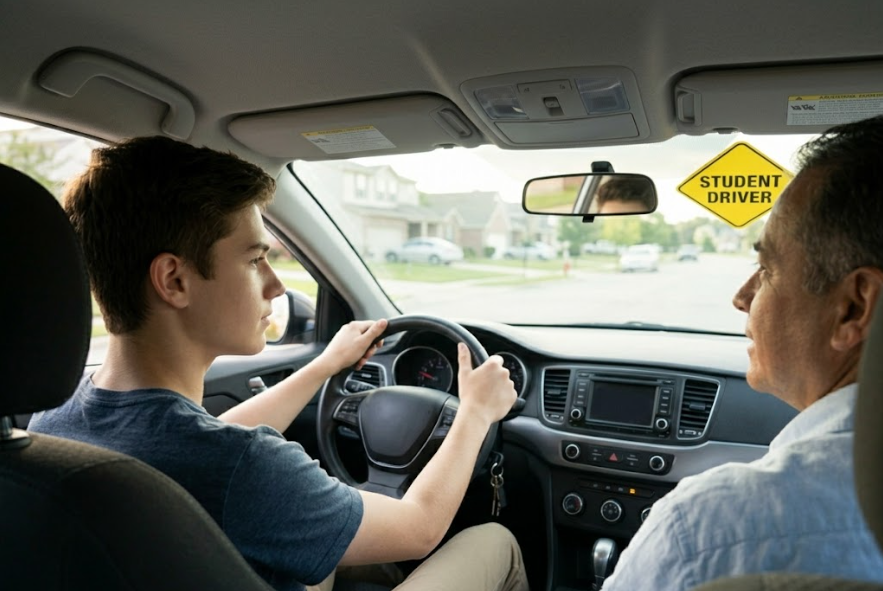
A lot of learner drivers spend too long either under-challenged or over-stressed. They are either stuck on roads that do not move them forward, or thrown into situations they are not ready for. Fleet, Hook and the wider Hart District manage to avoid both extremes. That is what makes them so good for driving lessons.
Fleet is an excellent example of what balanced road learning looks like. It has residential areas where beginners can settle into the basics, but it also has busier roads, larger roundabouts and main routes that start demanding more from the learner quite early on. This creates a healthy learning curve. Someone can begin by focusing on car control, then fairly quickly move into the road-reading and decision-making that make driving feel real.
Hook adds another useful layer. Its road network gives access to local village-style routes and larger connecting roads, which means learners are not trapped in one style of driving. They begin to understand how the same good habits apply in different settings. A proper mirror check matters whether you are on a quiet residential road or joining a busier road. Good positioning matters whether you are near parked cars or heading towards a larger roundabout. That continuity helps skills stick.
Hart District more widely supports this kind of development. The area offers enough variation that lessons can be built with a purpose. An instructor might decide one lesson is about roundabouts and lane discipline, another about open-road confidence and another about smoother control in residential settings. That sort of deliberate structure makes lessons more effective than simply “going for a drive”.
One of the strengths of learning around Fleet is that it teaches drivers to adapt. Town roads ask one set of questions: how well do you read junctions, how do you manage parked cars, can you keep things smooth when traffic is stop-start? Larger roads ask another: can you judge speed properly, keep safe spacing and plan ahead? Learners here get to practise both. That tends to produce new drivers who are less rattled when they meet something unfamiliar later on.
Fleet also encourages sensible ambition. Learners can feel stretched without feeling lost. They are asked to cope with proper traffic, larger junctions and everyday pressure, but in an environment that still feels manageable. That is one reason confidence often grows well here. The challenge is real enough to matter, but not so intense that each lesson becomes discouraging.
Hook, meanwhile, often helps learners with rhythm. The roads there can feel slightly less compressed than in busier town centres, which gives learners time to plan and understand what they are seeing. That can be especially useful for people who are still learning how to think ahead. Once they realise they do not have to react at the very last moment, their driving starts to calm down and improve.
Another important point is that this area works well for different kinds of learners. Young beginners, nervous adults, returners and people who need a slower pace can all progress here because there is enough road variety to adapt lessons to the individual. A good instructor can start quietly and then dial up the complexity when the learner is ready.
From a lifestyle point of view, learning locally in Fleet or Hook is often the smartest option. You build experience on roads you are likely to use in normal life. That could mean driving to work, reaching the station, visiting friends or joining nearby bigger roads for longer journeys. The more familiar the area becomes during lessons, the less intimidating independent driving feels once you pass.
Search interest around “driving lessons Fleet” and “driving lessons Hook” usually reflects a practical mindset. People are not just asking who can give them lessons. They want to know whether the area itself will help them become a confident driver. In this case, it absolutely can. The road mix is broad, the progression is natural and the local environment supports structured learning very well.
Fleet and Hook may not have the dramatic reputation of a major city or the simplicity of a rural backwater, but that is exactly the point. They sit in the middle, and that middle ground is often where the best learning happens. You get enough quiet to learn properly, enough challenge to improve steadily and enough realism to feel ready for life after the test. That is a better mix than most areas offer.