


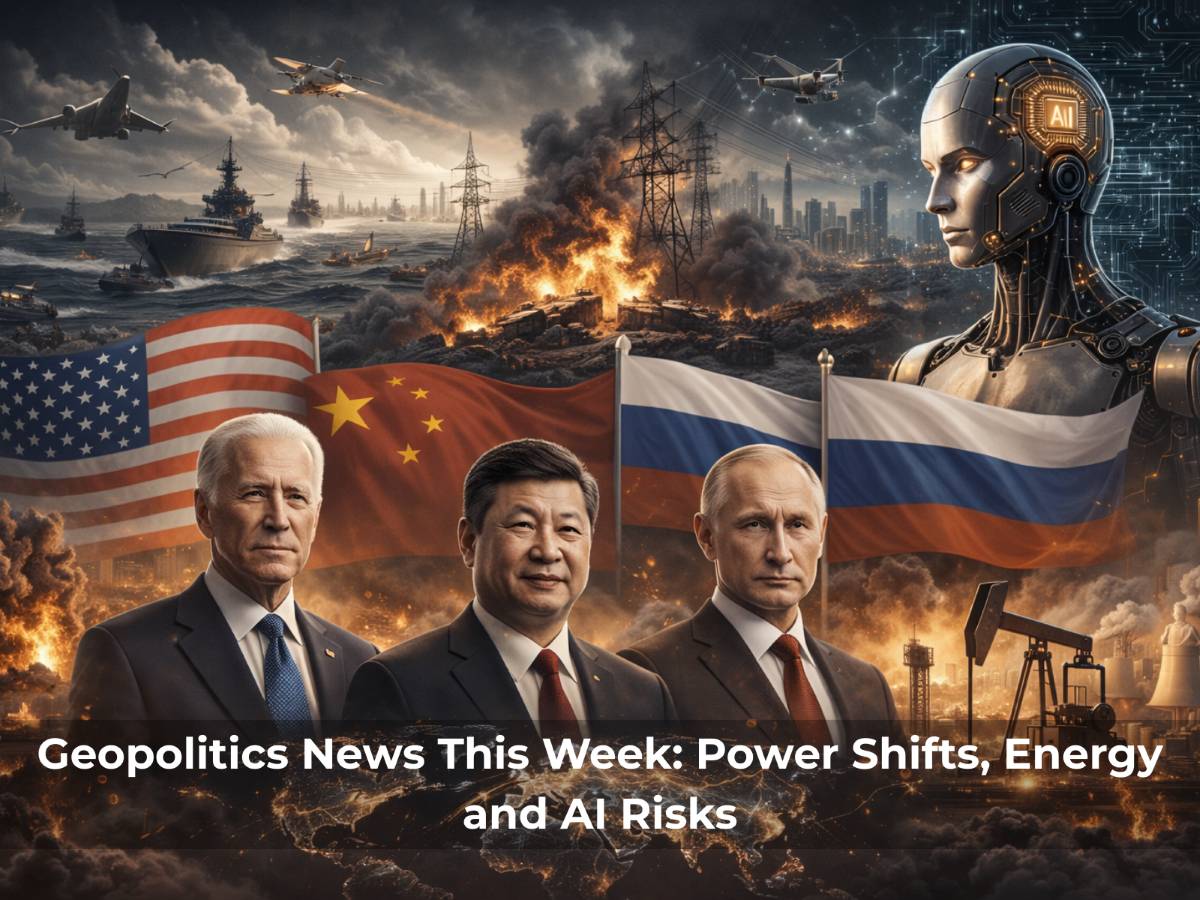
The geopolitics news this week shows just how quickly the global order can shift. Power is not fixed. It is constantly being tested, negotiated and sometimes forced into a new shape. From American strategy in Latin America to nuclear diplomacy with Iran, and from trade realignments to AI driven market volatility, global politics and global markets are now deeply intertwined.
What stands out in the geopolitics news this week is not just conflict, but recalibration. Governments are reassessing alliances. Markets are repricing risk. Businesses are rethinking supply chains. And artificial intelligence is increasingly part of the same conversation as sanctions, oil and defence policy.
US Power Projections and the Western Hemisphere
A recent geostrategic analysis highlights a sharper US focus on the Western Hemisphere. Reports surrounding developments in Venezuela and the political future of Nicolás Maduro have reignited debate about Washington’s role in the region. Any direct or indirect intervention carries implications not only for governance, but also for oil markets and regional stability.
From an energy security perspective, this matters. Despite years of discussion about renewables and decarbonisation, oil supply remains central to strategic planning. The geopolitics news this week makes it clear that access to energy resources is still a powerful driver of foreign policy decisions.
For Latin American governments, the message is equally significant. Domestic political developments can quickly become part of a wider geopolitical contest. That reality shapes everything from trade negotiations to defence cooperation.
US–Iran Tensions and NATO Reassurance
In the Middle East, nuclear diplomacy remains fragile. Ongoing tensions between the United States and Iran continue to influence global risk sentiment. Talks aimed at containing nuclear development are unfolding alongside sanctions, regional proxy conflicts and internal political pressures.
At the same time, Washington has sought to reassure allies within NATO. European leaders are watching closely, particularly as security concerns related to Russia and broader regional instability remain high. The geopolitical analysis this week shows a balancing act: a willingness to act decisively when national interests demand it, paired with efforts to maintain long standing alliances.
This dual approach is central to the geopolitics news this week. Strategic autonomy, alliance management and deterrence are all unfolding at once, often under intense domestic political scrutiny.
Middle Powers and a More Complex Global Order
Another key theme in the geopolitics news this week is the rise of middle powers. Countries such as Canada and the European Union are pursuing broader trade networks and diversified partnerships. The United Kingdom is also recalibrating its economic and diplomatic relationships, seeking flexibility in a more fragmented global environment.
Rather than aligning rigidly with one superpower, these actors are hedging. They are negotiating tariff reductions, expanding regional agreements and investing in strategic sectors such as energy transition, defence technology and semiconductor supply chains.
This reflects a deeper trend in global politics. The world is no longer structured around a single axis of power. Instead, it is shaped by overlapping interests, regional blocs and issue based coalitions. That complexity is a defining feature of global political risk in 2026.
Energy Security, AI and Market Volatility
Financial markets are responding. Surveys of trading professionals suggest that geopolitical tensions now rank above central bank policy as a driver of market volatility. Close behind is artificial intelligence.
This pairing is telling. The geopolitics news this week shows that geopolitical risk and AI disruption are no longer separate themes. Semiconductor supply chains, rare earth minerals, data infrastructure and cyber security all sit at the intersection of technology and statecraft.
A diplomatic breakdown can disrupt chip exports. Sanctions can reshape access to advanced AI hardware. At the same time, AI systems influence information flows, election security and even military planning. Investors increasingly treat global security risks and AI regulation as interconnected forces shaping currency markets, commodity prices and equity valuations.
For businesses, this means geopolitical analysis is no longer optional. It is central to strategy. Supply chain resilience, energy diversification and regulatory compliance in AI and data governance are now board level issues.
What the Geopolitics News This Week Really Signals?
Stepping back, the geopolitics news this week underscores three broader signals.
First, energy security remains fundamental. Oil, gas and critical minerals still shape foreign policy choices, even as climate commitments evolve.
Second, alliances are being tested but not abandoned. Institutions like NATO remain relevant, yet member states are also exploring greater strategic independence.
Third, artificial intelligence is becoming a geopolitical variable. It affects competitiveness, defence capabilities and economic growth. The boundary between technological competition and geopolitical rivalry is fading.
For policymakers, the challenge is to reduce vulnerability without retreating into isolation. For businesses, it is to plan for sudden regulatory, trade or security shifts. For individuals, it is to recognise that global politics influences everyday realities, from fuel prices to investment returns.
In short, the geopolitics news this week is not background noise. It is a reminder that power, technology and markets are now deeply connected. Understanding that connection is essential for navigating global uncertainty in 2026 and beyond.


